Showing posts with label How to Play with Children with Disabilities. Show all posts

Sunday, October 27, 2013

Sensory Integration: How to Calm a Hyper Child without Wearing Yourself Out.

Calming a hyper child can wear you out, unless you wear them out first.

The child in this video is constantly in motion, it is very difficult to get him to focus on fine motor tasks and he is young so if the activity isn't fun, he isn't doing it.  This activity gives him deep pressure and heavy work and helps him to gain better body awareness and ends with him being calmer.

The tube this child is playing in is a length of knit cloth from a fabric store that comes in a 'tube'.  You can also purchase body socks made of neoprene from therapy catalogs that do the same thing.

If anyone else has suggestions please share.


Friday, October 18, 2013

Finding the Right Sensory Channel for Learning

This post is how to teach an 8 year-old student with moderate to severe cognitive delays.  Our student, we'll call her Ashbury besides having cognitive delays also exhibits symptoms of cortical blindness and is hypersensitive to vestibular stimulation.  Ashbury has difficulty learning new tasks.  Many learning approaches have been attempted with Ashbury, the issue seems to be finding the right sensory channel to teach Ashbury.  By sensory channel I mean figuring out how Ashbury learns about her environment and working with her through that channel.

Vision:
Ashbury is able to match colors and can see but does not appear to utilize her vision as her primary sense to interact with her environment.
  • When Ashbury is putting objects in a container she does not visually search for the objects to put into the container, she uses her hand to feel around for the objects.  
  • When stacking blocks Ashbury does not look at the blocks she is stacking she 'feels' the blocks and tries to stack based solely on tactile input.  

Tactile: 
Based on how Ashbury does visually, you'd think she would be a tactile learner.
  • Ashbury is not able to feel simple objects (such as a ball) and then choose a similar object out of two objects (ball and spoon) presented based on tactile input (poor stereognosis.)
  • Ashbury is not able to feel the outline of a slot and orient a disc to the slot.
Kinesthesia:
  • Ashbury's movements are stiff and close to her body.  She exhibits gravitational insecurity and attempts to limit movement.
Auditory:
  • Does not follow verbal directions well.
  • Has very limited word phrases she utilizes.
  • Does not seem to be hyper or hypo sensitive to sound.
Olfactory:
  • Does not seem to react to scents.
Gustatory/Taste:
  • Food preferences unknown.
  • Tends to bite on things occasionally, more apt to bite on objects when frustrated.
The backpack:

Goal:  To put on backpack correctly independently every time. Ashbury continually has difficulty orienting the backpack correctly, it often is upside down or the straps are wrong.

Baseline:  Ashbury could put on backpack correctly independently 15%.

Progress: 
  • If Ashbury grabs the backpack by the loop at the top of the backpack we have developed a motor pattern so that she is able to put the backpack on correctly 90%.
  • Problem Ashbury is not able to identify or maybe understand where the loop at the top of the backpack.

Intervention:
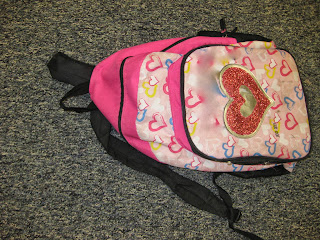
    • As mentioned before, Ashbury is able to put her backpack on correctly 90% of the time, if she grabs the top strap with her right hand. However, she doesn't always find the correct strap and usually ends up with her backpack on incorrectly.
    •  In order to help Ashbury orient herself, we decided to connect a kush ball to the top loop. We thought that because she doesn't interact with her world primarily through her visual channel, that she could be compensating with her tactile senses. 
    •  The kush ball was unsuccessful and she continued to struggle with finding the correct strap. At this point it was clear that Ashbury's primary sensory channel is neither visual nor tactile. At this point we found a shiny silver piece of material that crinkles together. We decided to tie it to the correct strap for her next session. 
    •  The idea was that this material would be visually, tactily, and even auditorily stimulating. With this new material on her backpack, Ashbury is able to grab any strap and put it on correctly. I believe that Ashbury uses all of her senses when interacting with the world. When one sense fails her, she moves on to the next. She learns best when an activity engages at least three of her senses at once.

    Friday, June 3, 2011

    Special Needs Kids: Therapy/Early Intervention Strategies

     A recent study published in The American Journal of Occupational Therapy (AJOT), Identifying Strategies Early Intervention Occupational Therapists Use to Teach Caregivers, compared different occupational therapy strategies and outcomes.  The study focused on the vital role of the family as the teacher of the child and the role of the therapist as the family educator. 

    The study compared Early Intervention service approaches of therapists with children requiring therapeutic intervention and the families most often the moms.  This study although conducted with Early Intervention service providers can be generalized to outpatient therapists, school therapists (teacher having caregiver role) and many other venues in which OT is practiced.


    Thursday, May 19, 2011

    Special Needs Children: Developmentally Disabled: Small victories


    I work with severely multiply impaired children ages 3-6.   Like many of us in this field I came into special education with a lot of big ideas. I was going to change their world. Very quickly I realized that it would not happen over night. And I would need to embrace the small victories to keep from feeling like a failure. Soon after I realized that would be enough for me.

    Saturday, April 23, 2011

    Special Needs Kids: Working with Disabilities: Cortical Visual Impairment

    As a Paraprofessional in a classroom for Severe Multiple Impairments I work everyday with Cortical Blindness. Cortical Blindness is also often referred to as Cortical Visual Impairment or CVI, basically a neurological disorder where the occipital cortex of the brain doesn't know how to process or properly interpret what the eyes are seeing.

    Four major causes of CVI:
    • Asphyxia

    • Brain maldevelopment

    • Head injury

    • Infection


    Thursday, January 27, 2011

    Disability Doll

    Down Syndrome Dolls White Girl
    Take a look at the doll in the picture. What do you see? You'll probably notice almost immediately that its face is not as “regular” as the rosebud-mouthed, snub-nosed dolls that come as standard in toy shops. But if you picked it up and examined it more closely, you'd see that they are not the only features that you don't find on a “normal” doll: a horizontal crease in the palm of the hand, the ears set low on the head, a flattened bridge across the nose, a slightly protruding tongue.

    Saturday, December 11, 2010

    Playing with Severely Impaired Special Needs Kids - Part 2

    As professionals working with children that have severe disabilities we have found that there are ways to play with common toys and connect with your loved one and motivates them to move and do things you may not have seen before!  These short clips reveal just that - simple techniques of how to make "play time" with your child more fun for both them and you.
    This video is embedded through YouTube

    ShareThis