
Showing posts with label children disability. Show all posts
Showing posts with label children disability. Show all posts
Wednesday, November 2, 2016
Apps Can Promote OT
Although it may be true that kids are getting enough screen time as it is, I think an Ipad/tablet is an effective tool for therapy because of the amount of finger skills, and visual/cognitive benefits it provides. It is a great way to use as a 'reward' at the end of therapy or at the end of a task. Depending on the app, they can help reinforce pincer grasps, letter formation, finger isolation, and visuomotor skills. Here are few below that would be helpful in the world of pediatric occupational therapy one of which I enjoy using.


Tuesday, September 25, 2012
Boy With Autism Hits Himself when He Sees His Hands
-->
I work with a 6-year old boy with autism who hits himself violently in the head whenever he sees his hands. Over the summer the boy's mother put weights on his hands and the boy didn't hit himself when he was wearing the weights. Now the weights don't work, the only thing that works is if the boy has a blanket covering his hands.
If the boy has a blanket over his hands he is able to play, utilize his hands functionally, and not hurt himself. If the boy has mittens on he hits himself. If the blanket is held above the boy's hands he does not hurt himself but will utilize his hands functionally.
Anyone have any ideas?? This child needs help.
Friday, March 23, 2012
Monday, February 20, 2012
Special Needs: Why do kids put things in their mouth?
There are different reasons why children put things in their mouth:
1. If they are chewing it, they may be seeking proprioception input. So if you take it away, their central nervous system will find another way to get its proprioception input.
2. If they are sucking it, they may be seeking tactile input...
1. If they are chewing it, they may be seeking proprioception input. So if you take it away, their central nervous system will find another way to get its proprioception input.
2. If they are sucking it, they may be seeking tactile input...
Saturday, April 30, 2011
Special Needs: What is Autism/Autism Spectrum Disorder (ASD)?
What is Autism?
Good question, it means different things to different people. Maybe the question what we really want to know is who are these autistic people?
So who are these autistic kids anyway?
I've been working with kids diagnosed with autism for the past 13 years, they are all different and many kids with cognitive impairments have autistic behaviors. By autistic behaviors I mean self stimulating behaviors like arm flapping, stimming off of lights, moving fingers in front of their face and watching intently, flipping objects, spinning objects, perseverating, those kinds of things.
Tuesday, April 12, 2011
Disability, Special Needs Children: Mom Struggles with Undiagnosed Genetic Syndrome
by Michele Juda
 This
is how today started…no less than eight phone calls were made in
relation to my son Devon. I talked with the supply company (twice), the
GI office (twice), the pediatrician, the geneticist, the director of
special education services for our school district, and Devon’s service
coordinator. When I got done with all that, my
husband tried to lighten the mood by saying, "Gee, you would think this
kid had a disability or something!"
Yeah, you would…or would you?
From Complex Child emagazine:
Click here to read more.
Friday, April 1, 2011
Occupational Therapy: Sensory Integration Warm-Ups for Special Needs Children/Disabled Kids
As an occupational therapist working with special needs children I find that sometimes it is very difficult to find fine motor activities that cognitively impaired kids can not only understand but enjoy. As with any other population when working on improving fine motor skills with special needs children I always use the same formula.
- Begin with a warm-up activity. Warm-up activities usually include sensory integration, gross upper extremity activities and move into fine motor warm-up activities prior to working on fine motor goal work.
- Try to incorporate neurodevelopmental techniques (NDT) into activities.
- Fine motor skills/activities that are functional.
Monday, February 7, 2011
Increasing Feeding Tube Awareness- February is Feeding Tube Awareness Month
Feeding Tube Awareness Week
by Traci Nagy
It started with Sesame Street. My two and a half year old son, Lucas, and I watch Sesame Street most mornings. Lucas has a rare chromosomal microdeletion that has caused him to have complete gastroparesis (paralysis of the stomach), among other GI disorders and developmental delays. He has been on a feeding tube nearly his entire life.

Lucas at 8 months of age with Elmo
CLICK ON THE LINK BELOW TO READ MORE:
http://articles.complexchild.com/feb2011/00273.html
by Traci Nagy
It started with Sesame Street. My two and a half year old son, Lucas, and I watch Sesame Street most mornings. Lucas has a rare chromosomal microdeletion that has caused him to have complete gastroparesis (paralysis of the stomach), among other GI disorders and developmental delays. He has been on a feeding tube nearly his entire life.
Lucas at 8 months of age with Elmo
CLICK ON THE LINK BELOW TO READ MORE:
http://articles.complexchild.com/feb2011/00273.html
Monday, January 31, 2011
Definition of Cerebral Palsy vs Chromosomal Syndrome for Children with Special Needs


Recently I was sitting in a meeting regarding a special needs child, when one of the professionals in the meeting asked for the child's diagnosis. A couple of people responded 'cerebral palsy' a couple of people didn't think that was the case.
I didn't think that was the case because the boy was 11 years old and the size of a 5 year old. When we checked the file we realized he was diagnosed 'Mosaic Down's Syndrome.'
I didn't think that was the case because the boy was 11 years old and the size of a 5 year old. When we checked the file we realized he was diagnosed 'Mosaic Down's Syndrome.'
Tuesday, January 18, 2011
Thursday, December 16, 2010
10 things I learned working with developmental disabilities
It's good to periodically review some of the lessons life teaches you... here are a few of the things I am learning as a student in occupational therapy working with kids that have severe cognitive impairments...
10. It’s good to wash your hands
A lot of the kids I work with think that putting soap on their hands and rinsing it off is enough… learning how to wash hands independently is an important skill that should not be overlooked!
9. Don’t be afraid of the obvious
I learned yesterday from a young man that it is important to choose your battles. I wanted to have him practice putting his coat on and off…. He only wanted his coat on. After a few minutes – I had to settle for the obvious… he was going to win this battle and his coat was gonna stay on – so… we began learning how to zip coats instead
8. Don’t be afraid of a mess
This lesson was from the kids that I teach how to use utensils at the table. It’s okay to be a little messy as long as you are learning… long towels work as good bibs too
Click "read more" for more...
Wednesday, December 15, 2010
Mother with Aspergers shares insight into autistic behaviors

An Article Found at: "Autistic Self-Advocacy Network"
"Melody is not only raising two sons with Autism Spectrum Disorders (ASD), she also lives with one herself. Like my 7-year-old son Ethan, Melody lives with Asperger's Syndrome. Thanks to her unique point of view, Melody often has very helpful ideas and suggestions for other parents raising kids living with ASD.
Click "read more" to complete the article
Click "read more" to complete the article
Down's Syndrom Marriage
‘Monica & David’ Explores Marriage With Down Syndrome
When Monica and David Martinez got married five years ago, they were not your average bride and groom — both have Down syndrome. Deeply in love and committed to each other, their union nonetheless put the couple among a minority of people with developmental disabilities walking down the aisle.Filmmaker Alexandra Codina — who is Monica’s cousin — followed the couple through their wedding and first year of marriage. The resulting documentary “Monica & David” captures the couple as they adjust to life together and struggle to define their own independence.
Ahead of the premiere of “Monica & David” on HBO Oct. 14, Codina spoke with Disability Scoop.

Click "Read More" to read the article
Saturday, December 11, 2010
Playing with Severely Impaired Special Needs Kids - Part 1
As professionals working with children that have severe disabilities we have found that there are ways to play with common toys and connect with your loved one and motivates them to move and do things you may not have seen before! These short clips reveal just that - simple techniques of how to make "play time" with your child more fun for both them and you.
This video is embedded through YouTube.
What do you find that severely impaired kids like to play with?
This video is embedded through YouTube.
What do you find that severely impaired kids like to play with?
Playing with Severely Impaired Special Needs Kids - Part 2
As professionals working with children that have severe disabilities we have found that there are ways to play with common toys and connect with your loved one and motivates them to move and do things you may not have seen before! These short clips reveal just that - simple techniques of how to make "play time" with your child more fun for both them and you.
This video is embedded through YouTube
This video is embedded through YouTube
Playing with Severely Impaired Special Needs Kids - Part 3
As professionals working with children that have severe disabilities we have found that there are ways to play with common toys and connect with your loved one and motivates them to move and do things you may not have seen before! These short clips reveal just that - simple techniques of how to make "play time" with your child more fun for both them and you.
This video is embedded through YouTube.
This video is embedded through YouTube.
Friday, December 10, 2010
One Handed Kitchen Container
 As someone with cerebral palsy on the left side of my body, I have found that the tasks that prove the most challenging for me are in the kitchen. One simple product I found that made cooking less frustrating for me was the OXO "POP Container"
This way I do not have to struggle at all to open a container for my sugar, flour, or anything. The frustration it saves me is well worth the price. I am excited to get more for Christmas!
Features & Benefits

- Airtight seal with the press of a button
- Modular stacking system for optimal countertop and pantry organization
- Set includes: 1 4.0-quart Container, ideal for a 5 lb bag of flour or sugar. 1 2.5-quart Container, ideal size for rice, pasta, breadsticks. 1 2.4-quart Container, ideal for cookies, crackers. 1 2.1-quart Container, ideal for spaghetti, linguini, lasagna. 2 0.9-quart Containers, ideal for brown sugar, nuts. 2 0.5-quart Containers, ideal for tea bags, candy, sugar cubes. 2 0.3-quart Containers, ideal for spices, dried chilies, bouillon.
- Square shapes maximize space-efficiency
- Container corners allow for easy pouring
- Pop-up button serves as handle to lift off lid
- Also great for use in the garage, sewing room, play room and more
- Silicone gasket is dishwasher safe, hand wash other parts
- BPA-free
Katie Bekett - Independent Living

It started with a 3-year-old girl in a hospital and the president who was angered when he learned that federal rules prevented her from going home.
By what sense do we have a regulation in government that says we'll pay $6,000 a month to keep someone in a hospital that we believe would be better off at home, but the family cannot afford one-sixth that amount to keep them at home?
The president was Ronald Reagan. The girl, Katie Beckett, had contracted viral encephalitis, a brain infection, when she was just five months old. She'd gone into a coma for ten days, and when she came out she suffered a paralysis that left her unable to breathe without the help of a ventilator most of the day.
After more than two years living in St. Luke's Methodist Hospital in Cedar Rapids, Iowa, the family reached the limit of what its private insurance would pay for Katie's care. Medicaid, the state and federal health insurance for the needy, started picking up the cost of that expensive breathing machine and other care.
But Medicaid would pay only as long as the little girl lived in the pediatric intensive care unit at the hospital.
Beckett's parents, Julie and Mark, said they wanted their daughter at home. The girl's doctors agreed, saying she needed to grow up in a more normal environment than a hospital room.

Independent Living - Alternative Options
The following is an article from NPR:
What do you think - Should a 22 year old be living in a Nursing Home???
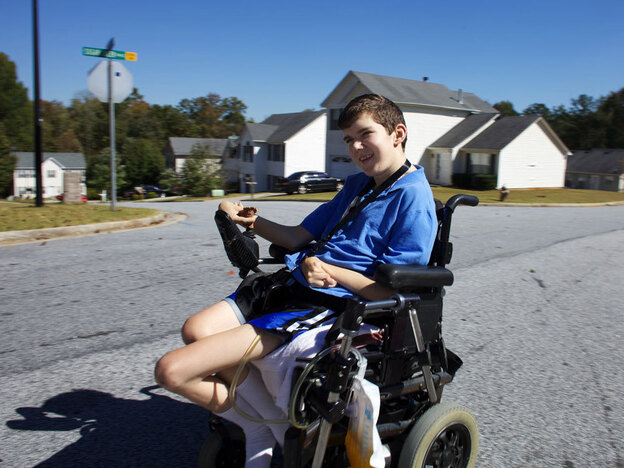
Click "read more" to read article
Mental Retardation
Saying that someone is "mentally retarded" has many connotations to it, and is no longer simply a "medical diagnosis". Instead, it is now encouraged to use the following words
- Intellectual Disability
- Cognitive Disability
- Learning Disability
- Developmental Delay
- Developmental Disability
Also, please use the phrase by putting the person first.... so as to not label them by a diagnosis. Example: "Instead of saying 'the autistic child' rather say, "the child who has autism".
Subscribe to:
Posts (Atom)